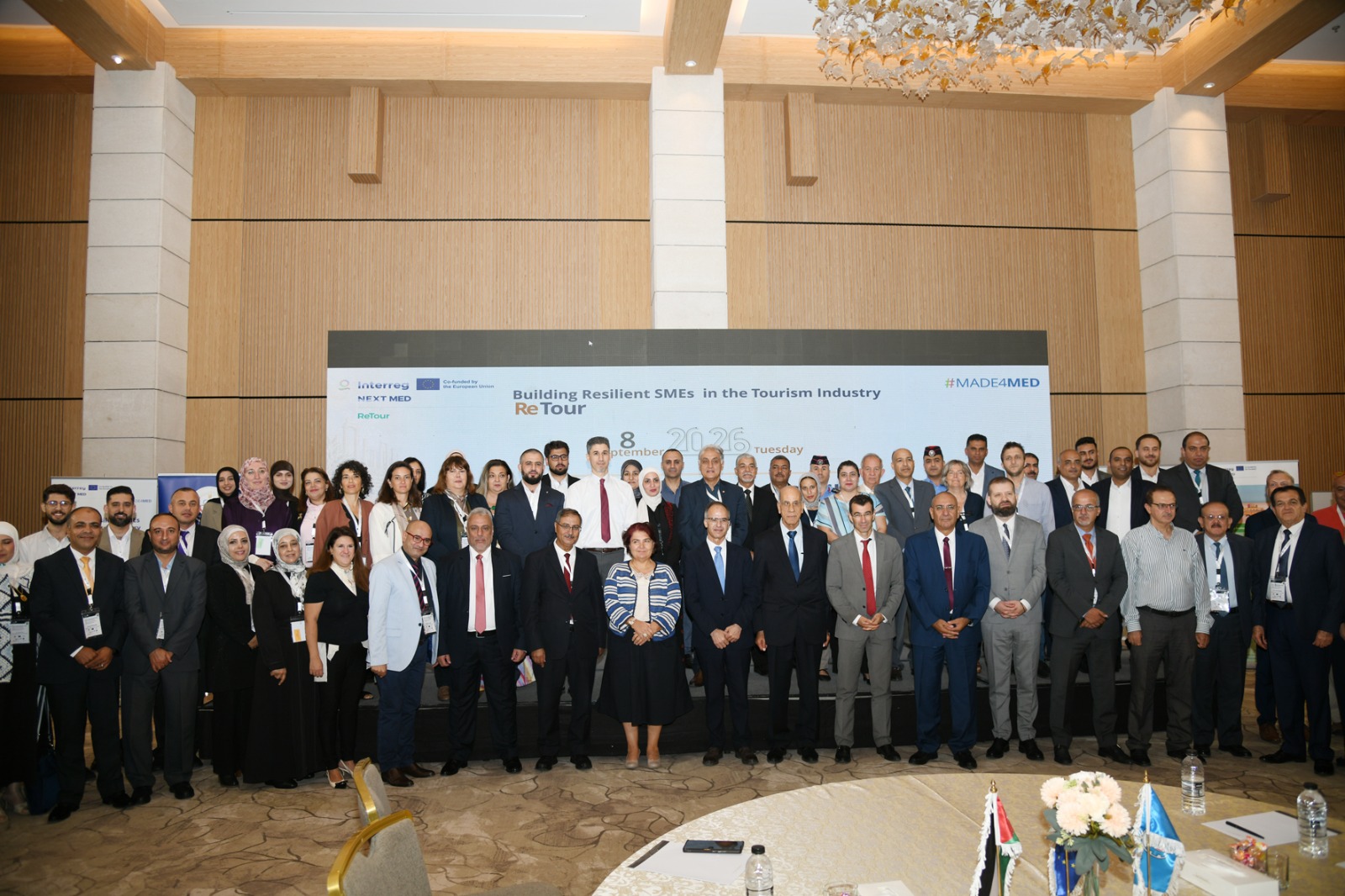
Under the Patronage of Sharifa Nofa Bint Nasser: Jordan University of Science and Technology and SPECTO Organize the Tourism Innovation and Resilience Forum, the First ReTour Project Meeting in Jordan
Under the patronage of Her Highness Sharifa Nofa Bint Nasser, Jordan University of Science and Technology and SPECTO (Computer Skills) held the Tourism Innovation and Resilience Forum on Tuesday, September 8, 2026, at the Landmark Amman Hotel, marking the first ReTour project meeting organized in Jordan.
The forum was held as part of the project "Building Resilient SMEs in the Tourism Industry – ReTour," funded by the European Union under the Cross-Border Cooperation Programme for the Mediterranean Basin (Interreg NEXT MED). The project aims to support micro, small, and medium-sized tourism enterprises, enhancing their ability to adapt, maintain continuity, and evolve through technology, innovation, digital transformation, and capacity building.
The event was attended by the representative of the President of Jordan University of Science and Technology, Vice President Prof. Dr. Ahmad Al-Ajlouni, and the Ambassador of the European Union to the Kingdom, Pierre-Christophe Chatzisavas, alongside several decision-makers, experts, academics, representatives from both the public and private sectors, international ReTour project partners, and key actors in the tourism domain.
Her Highness Sharifa Nofa Bint Nasser emphasized the importance of reinforcing the resilience of the tourism sector and proactively preparing for crises and changes, thereby enabling tourism enterprises—particularly small and medium-sized ones—to adapt and sustain operations.
She also highlighted the necessity of harnessing technology, artificial intelligence, and innovation to advance tourism, enhance Jordan's competitiveness, and elevate the visitor experience, delivering broader economic and social benefits for small businesses, youth, and women.
For his part, Prof. Dr. Ahmad Al-Ajlouni noted the importance of utilizing scientific research, technology, and innovation to support the tourism sector and strengthen its sustainability and resilience. He pointed to the role played by Jordan University of Science and Technology in developing applied solutions based on knowledge and innovation, as well as expanding its international partnerships to serve economic and developmental sectors and boost their competitive edge.
Dr. Mustafa Ali presented on the ReTour AI Brain platform and the role of artificial intelligence technologies in supporting tourism enterprises and building a smarter, more resilient, and adaptable tourism ecosystem.
He explained that the platform employs AI and data analytics to assist small and medium-sized tourism businesses, improving their ability to anticipate challenges and adapt. He also highlighted the role of the ReTour Innovation Hub in developing innovative solutions that connect academic and practical expertise with the actual needs of the tourism sector.
Prof. Dr. Ahmad Abu-El-Haija shed light on the significance of academia-private sector partnerships in transforming knowledge and scientific research into measurable economic and social value.
He reviewed SPECTO’s extensive experience spanning over twenty years in capacity building, digital skills development, and the implementation of large-scale training programs in Jordan and the region—including advanced digital skills and artificial intelligence—stressing the importance of aligning knowledge and technology with the needs of economic and developmental sectors.
The forum discussed current trends in artificial intelligence, digital innovation, and business early warning systems, featuring a panel of international experts. Dr. Morten Møller addressed the role of early warning systems in detecting early indicators of enterprise distress and managing them before they turn into full-scale crises, enabling businesses to prepare early and make more effective decisions.
In turn, Dr. Sami Abu-El-Haija discussed the role of artificial intelligence and digital innovation in constructing smart and adaptive tourism ecosystems, explaining the importance of deploying technology and data to refine tourism business performance and bolster their capacity to deal with challenges and adapt to changes.
The forum featured a live demonstration of the ReTour Innovation Platform and its AI-driven smart ecosystem, alongside a participatory approach to test, refine, and validate the platform’s alignment with the actual requirements of enterprises and stakeholders operating in the tourism sector.
The co-assessment and development workshop addressed four main tracks:
Platform Usability and User Experience
AI Capabilities and Smart Agents
Tourism Enterprise Needs, Innovation Services, and Collaboration
Data Sharing, Validation, Governance, Sustainability, and Policy
The workshop allowed participants to share feedback and recommendations regarding the platform's features, services, and user experience, guiding its development in line with the realities of the tourism sector and the needs of SMEs.
Furthermore, the policy dialogue session, titled "Building a More Resilient and Innovative Tourism Ecosystem," discussed the transition from reactive crisis management to proactive preparedness. It stressed the roles of policy, skills, data, digital transformation, sustainability, and public-private partnerships in building a more adaptable and sustainable tourism sector.
The forum affirmed the critical importance of supporting small, medium, and family-owned tourism enterprises due to their direct role in providing jobs and income for thousands of families, as well as the substantial economic and social significance of the tourism sector in Jordan and across the Mediterranean region.
Discussions also highlighted that effective digital transformation in tourism goes beyond adopting new technical tools; it begins with understanding business needs and challenges, selecting appropriate solutions, and building the necessary capacity to deploy them efficiently—yielding tangible impacts on operational performance, visitor experience, service quality, and decision-making.
The forum concluded with several key recommendations, most notably: continuing the development of the ReTour digital platform to incorporate feedback from tourism sector representatives toward its final release, and responding to the digital tool and service needs of small and medium-sized tourism enterprises.
The forum further recommended enhancing collaboration and innovation among tourism stakeholders at both national and regional levels, while continuing to engage enterprises and relevant bodies in shaping project outputs and establishing future priorities to ensure the ReTour project responds directly to actual sector needs.
Jordan University of Science and Technology and SPECTO are co-implementing the ReTour project in Jordan within an international partnership uniting institutions across the Mediterranean region. Their joint responsibilities include studying tourism enterprises' needs and digital readiness, engaging sector stakeholders, contributing to the development of technical solutions, and executing training programs, capacity-building initiatives, and project activities across the Kingdom.
SPECTO’s role in the project underscores the company's commitment to deploying its technical, digital transformation, innovation, and capacity-building expertise within practical, sustainable international projects. By connecting technical solutions directly with economic sector demands, SPECTO supports institutional performance, fostering growth and competitive potential.
The Tourism Innovation and Resilience Forum represents an essential launchpad for Jordanian tourism sector participation in the ReTour project and a practical step toward converting enterprise needs into actionable priorities and solutions—contributing to a more resilient, innovative, adaptive, and competitive tourism industry.